Estimated reading time: 7 minutes
This year’s Mohair South Africa (MSA) conference, which took place on 19 June at the Botanics in Graaff-Reinet, saw a good turnout of guests, farmers, and stakeholders across the value chain, from farmers to buyers, spinners, brokers, and various other industry role-players.
Mohair SA covered its new brand reset strategy and the different focus areas in the organisation, while the core message of the day was how certain challenges in the industry can be turned into opportunities for the South African mohair industry, and how sustainability initiatives such as the SPIN360 project can help to future-proof the industry in the years to come.
Read more about Mohair SA’s brand reset that took place earlier this year.
Growing demand for certain segments of the natural fibre of choice
As MSA’s chairperson, Chris Hobson made use of the opportunity to review the position of South African mohair, which produce more than 50% of the world’s mohair. He confirmed that there is definitely a growing demand for kid mohair and that Europe is gradually coming back on board buying kid hair. “From an industry perspective, MSA consists of a good team of people who represents the local mohair industry at all the notable events around the world.
The organisation has also come a long way on the global stage and is doing a lot of work to attract attention to mohair as a niche natural fibre,” he said. “We have invested in two life cycle analysis, one of which is Integrity Ag, an Australian-based company, and SPIN360, an Italian company which already works with all the top fashion brands in the world. Mohair South Africa is really hoping for a seat around the table with all of those fashion houses, making mohair the natural fibre of choice.”

Graduations at the Mohair Empowerment Trust
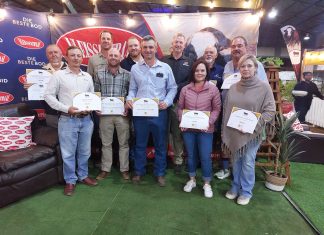
Beauty Mokgwamme, the empowerment & training officer of the Mohair Empowerment Trust (MEP), presented the ongoing work of the trust which revolves around supporting mohair production through farmer development, mentorship, and technical training. “Three dedicated emerging farmers are graduating from our programme this year,” Mokgwamme said, “thanks to strong collaborations, committed funders, and knowledge-sharing platforms like Textile Exchange, whose support continues to uplift our mission. We have also hosted key funders and partners to display our progress and deepen engagement in empowering sustainable mohair farming.”
Looking ahead, the Trust will be expanding its footprint by onboarding new emerging farmers, strengthening community training initiatives, and deepening industry partnerships. “Our participation in international platforms like Textile Exchange will grow, ensuring global visibility and market access for our farmers,” Mokgwamme said. “With renewed funding commitments and strategic collaborations, 2025 promises to be a transformative year for inclusive mohair farming in South Africa.”

Materials Matter certification
Anne Heaton, Textile Exchange strategy lead for Animal Fibres and Materials, shared information about the Responsible Mohair Standard (RMS) which is being incorporated into the Materials Matter certification. On visit from the UK, she introduced the timeline/scope of the Materials Matter Standard, the Materials Matter certification mark, and what the new standard will involve.
“Incorporating the Responsible Mohair Standard into the Materials Matter Standard, is a change that people will see during the course of next year,” she said. “This particular standard brings all of the Textile Exchange standards together, but there will still exist an identity for mohair, wool and for all the other fibres that we certify. Farmers who are already certified for animal welfare and land management, will not see too many changes come into place. We are, however, expanding the social criteria which involves farmers and their employees, though we are also aware that there are already many laws and regulations that cover this in South Africa – so again, it may be new in our standard, but not going to be new to the farmers.”
While the standard was in its development phase, Textile Exchange has spent a lot of time talking to farmers around the world. “We came to South Africa last year and we did some pilot audits where we went on-farm with the certification bodies to try out this new standard. We also did workshops. We know it can be stressful when it seems like people are telling you how to farm, but we want to frame the standard in a way that recognises all the really great work that farmers are already doing and that they can have a certification mark to be really proud of.” Heaton concluded that the estimated time for the final version of the Materials Matter Standard will be made public in 2026.

Spin 360
The CEO of Spin360, Federico Brugnoli, joined the conference virtually and presented on the recent project with MSA. He noted that various luxury brands, including those that use mohair, has made public commitments to reduce the impact they have on the environment. He said that there are three ways for a brand to reduce its impact: 1. Buy less 2. Substitute materials 3. Buy better. Currently, if you look at the current textile environment impact data that are available to brands, it indicates that synthetic materials are more environmentally friendly than natural fibres, including mohair. The current project with MSA aims to provide accurate environmental impact data for mohair and at the same time provide the mohair industry with an anticipation report which can be used to guide the industry into the future.
Challenges and opportunities
In her presentation, Lauren Moore, head of communications and sustainability at MSA, touched on geopolitical conflicts, production challenges and dynamics, climate change and all of the worldwide forces that are impacting the mohair industry. She said that stakeholders and farmers in the industry are also under pressure, facing challenges across the board from which opportunity can arise, to put a positive spin on it.
“The mohair industry is niche, and a significant portion of the value chain comes from South Africa, including our farming communities who are producing more than half the world’s mohair,” she said. “Right from the Angora goats to the yarn that is spun, everything is really located in South Africa and in terms of what the brands are looking for, they are able to source it from a geographic location with the certainty of the ethical issues like animal and social welfare being in place, as well as transparency and traceability, which are all incredible positives for South Africa.”

According to Marco Coetzee, general manager of MSA, the conference has met all MSA’s expectations. “It is extremely important to be able to share all the relevant information with all our stakeholders, and we achieved that through this conference. I would like to thank all the farmers, industry role-players, MSA directors, and staff members for contributing to the success of the conference. I am looking forward to seeing how the mohair industry grows and moves forward into the next chapter. – Carin Venter, Plaas Media
For more information, contact Karla Esterhuyse, farmer liaison manager at MSA on 041 581 1681 or info@mohair.co.za.