Estimated reading time: 7 minutes
- Thamsanqa Justice Mxokozeli was the recipient of the Agricultural Research Council’s (ARC) 2024 National Kaonafatso ya Dikgomo (KyD) of the Year award.
- He farms with Bonsmara cattle, and produces proteas.
- The proteas account for 97% of his total farm income, the fynbos for 1,3% and the beef cattle 1,7%.
- Mxokozeli chose the Bonsmara because it is well adapted to the region’s climate, and produces high-quality, tender beef.
- He retains only cows that produce calves with good body condition every year.
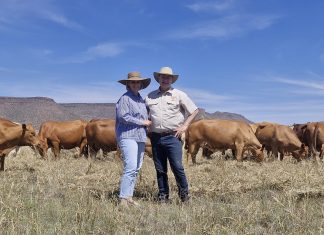
Thamsanqa Justice Mxokozeli from Riverside Farm near Bredasdorp in the Southern Cape was the recipient of the Agricultural Research Council’s (ARC) 2024 National Kaonafatso ya Dikgomo (KyD) of the Year award. He farms Bonsmara cattle, and produces proteas under irrigation as well as other fynbos in natural veld.
Mxokozeli say the KyD award means a lot to him. “The award will encourage me to grow from emerging to commercial farming, which is my daily dream. It will also encourage other emerging farmers, especially those who know my background.”
KyD is a dedicated animal recording scheme for emerging and smallholder farmers. The scheme is a special-purpose vehicle designed to facilitate smallholder participation in the mainstream livestock industries. Participation in the KyD scheme qualifies the participants to receive science-supported services that include information dissemination and technology transfer sessions regarding various livestock farming topics, ranging from basic animal husbandry practices, animal health, veld condition assessment, recordkeeping, market access, and the like.
Mxokozeli says his association with the ARC has been very beneficial. Performance testing conducted with the help of the ARC has played a major role in improving Riverside’s beef cattle herd. The improvements include a shorter intercalving period, cows that calve every year because adapted animals can be selected, as well as replacement heifers that calve earlier at the age of 28 to 30 months.
Mixed farming business
In respect of total farming income, Riverside Farm’s beef cattle component makes a small contribution; however, the cattle utilise a part of the farm that cannot be utilised for the other divisions, Mxokozeli explains.
He operates a mixed farming business consisting of a Bonsmara herd of 63 head, 16ha of proteas under irrigation, and 702ha of natural veld on which fynbos is harvested under contract. The proteas account for 97% of his total farm income, the fynbos for 1,3% and the beef cattle 1,7%.
Most of the time the cattle graze the same natural veld where the fynbos is harvested. Supplementary grazing comprises of 20ha of kikuyu pasture that is utilised in autumn as soon as the first rains have fallen, and 133ha of oats and clover pasture cultivated each year for use in July, August, and September.
Riverside Farm’s average rainfall is 405mm per year with its wet season from May to October. The farm’s maximum temperature ranges from 29 to 30°C in the warm months to 15 to 16°C in the cold months. In July, the coldest month, the temperature can range between 8 and 19°C during the day.
Why the Bonsmara?
Mxokozeli chose the Bonsmara because it is well adapted to the region’s climate, and produces high-quality, tender beef. The cows have good mothering ability and wean heifer and bull calves with weaning weights ranging from 208 to 257kg. Good disease control and adequate nutrition ensure that the cows calve and wean a calf every year.
At the time of writing, Riverside Farm’s 63 Bonsmaras consisted of 40 cows in production, seven replacement heifers, 12 weaners and four calves. The weaning percentage of the cows is 98% and calves are weaned at seven months of age. The weaner calves are rounded off on the farm and sold at the age of 18 months, when the heifers and bulls weigh from 308 to 450kg.
The limiting factor in his farming setup is the grazing, which keeps him from increasing the herd. “I can go up to 50 breeding cows, but anything more will require buying additional land. The high land prices of more than R200 000/ha do not make economic sense,” he says.

Set for production
He strongly believes in the principle that his breeding cows must wean a calf every year, otherwise they are sold. When choosing breeding cows, milk production is important. Cows must produce enough milk to wean a healthy calf. Cows must also maintain their condition during this period.
The bulls he uses must be big and muscular, have a good temperament, and pass those traits on to their offspring. Their calves must maintain a good growth rate.
Mating season is from October to December and the calving season from July to September. Heifers are mated for the first time at 20 months of age. “I want young, productive animals in my herd and therefore I regularly replace the old cows with heifers that meet the herd’s selection requirements. I use the KyD 18-months performance report to select the best performing heifers,” says Mxokozeli.
The criteria he uses for selecting replacement heifers are birthweight, pre-weaning weight at 100 days, body size, conformation, weaning weight, growth rate, age, and physical development.

ARC’s role in Riverside Farm
The ARC’s KyD scheme assists him in utilising beef recording and improvement technology to facilitate accurate selection for economically important traits, as well as increased productivity and profitability in his herd. “Armed with the ARC reports I can easily select breeding animals that are best suited to Riverside Farm’s farming conditions.
“With the help of the ARC I can see the profit in this farm, which is fuelling my interest in expanding the beef cattle production side. I know that keeping animal records are vital. Weighing the animals plays a huge role in my decision-making.
“A team of the ARC visits the farm regularly to weigh the cattle, record the information, and later send me a report that assists in my management decisions. I’ll provide them with the birthweight, and they perform the pre-weaning weighing at 100 days, the weaning weight at seven months, and weighing the heifers at 18 months.”
Necessity of performance testing
By keeping records of births, the pre-weaning, weaning and post-weaning weights of each calf, intercalving periods, age at calving, each animal’s identification, and growth rate you can, among others, determine the mothering ability of each cow and perform accurate selection of replacement heifers, says Mxokozeli.
He retains only cows that produce calves with good body condition every year. A cow has to calve every year. Cows and heifers that take too long to conceive, as well as those that do not raise a calf, are sold.
When selecting replacement heifers, aspects such as pre- and post-weaning weight and body condition play a major role. These traits indicate whether cows possess good mothering ability and are adapted to the farming conditions.
Main challenges
Riverside Farm’s main risks include animal diseases, flooding of cultivated pastures in the rainy season, expensive feed, and fencing to divide camps. Mxokozeli manages these risks by vaccinating the animals regularly according to the state veterinarian’s vaccination schedule and keeping the animals in safe areas during flooding.
He has to buy in large quantities of supplemental feed (hay bales and protein blocks) every year. Sometimes he buys maize that is mixed with molasses, minerals, and oat hay. Hay bales are put out from April when the grazing becomes scarce so that the animals can maintain their condition. During this time he also puts out protein blocks until the grazing starts to improve. – Hugo Lochner, Plaas Media
For more information, contact Thamsanqa Justice Mxokozeli on 082 938 9841 or send an email to iqhudefarms@gmail.com.