
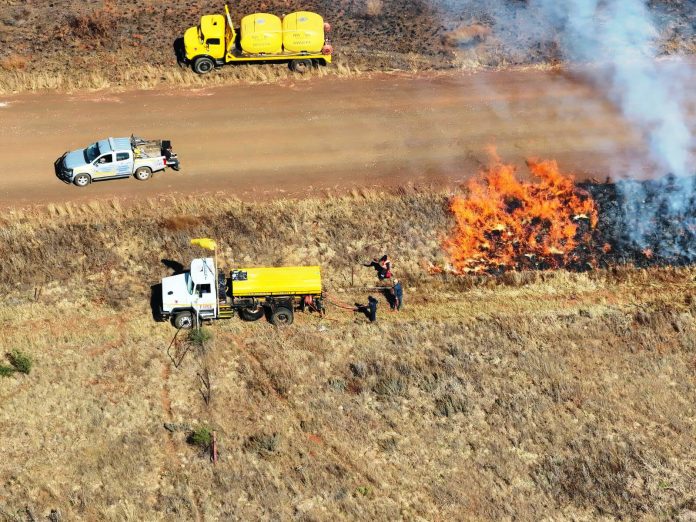
The Department of Forestry, Fisheries and the Environment (DFFE) has confirmed that its new national wildfire management implementing agent will operate from 1 August 2026 to 5 January 2028. This follows the appointment of the TEFLA Group (Pty) Ltd as the new service provider, replacing the Working on Fire (WOF) Kishugu Joint Venture (JV), which has been performing this service for many years until recently.
Replying to our enquiry, DFFE director of communication and advocacy, Zolile Nqayi, told Agriorbit that the transition will not result in an acute employment crisis within the wildfire management workforce. The department will implement transitional measures with the current and/or newly appointed service provider. These measures are aimed at minimising operational disruptions and safeguarding the essential contribution of Expanded Public Works Programme (EPWP) participants to the Working on Fire programme.
Nqayi’s response follows concerns raised by stakeholders, including the North West Umbrella Fire Protection Association (NWUFPA). These concerns come amid an extensive legal history in which the previous five-year contract was set aside by the courts. In addition, the service provider was reportedly placed on terms on numerous occasions. Nqayi says the department entered into a memorandum of agreement (MoA) with the WOF-Kishugu JV on 30 December 2022 for a five-year period, from 6 January 2023 to 5 January 2028. However, following a High Court order from the Gauteng Division, Pretoria, under case numbers 60450/2022 and 66779/2023, issued on 1 April 2025, the DFFE was required to re-evaluate bids for tender DFFE-T041 (22/23).
After completing the process, the department informed WOF-Kishugu JV of the outcome and contract termination. Nqayi said the department has not repeatedly placed the service provider on terms; the department has implemented the court-ordered re-evaluation process to ensure compliance with applicable legislation, procurement prescripts, and the relevant judicial directive.
Concerns and third-party disputes
According to NWUFPA chairperson, Eric Stoch, the association has submitted a report to the National Veld and Forest Fire Protection Advisory Forum, highlighting alleged procedural flaws in the DFFE’s transition to a new wildfire management service provider. It also highlights the legal, operational, and structural implications for third-party beneficiaries.
Stoch said the DFFE has historically contracted the WOF-Kishugu JV under the National Veld and Forest Fire Act, 1998 (Act 101 of 1998) to provide firefighting services to umbrella fire protection agencies (UFPAs), fire protection agencies (FPAs), commercial farmers, businesses, traditional authorities, Khoi-San communities and vulnerable rural communities. He argued that UFPAs were not adequately consulted when the decision was made to place the service provider on terms, terminate or transition the programme, leaving key operational beneficiaries excluded from the process. According to Stoch, stakeholders only became aware of the changes post facto through informal social media updates rather than formal communication.
The NWUFPA also contends that, given the long-standing integration of these services into provincial disaster risk frameworks, the original contracting parties cannot unilaterally alter or terminate operations without structured consultation and transition planning involving affected beneficiaries. Stoch said the commercial contract between the DFFE and WOF-Kishugu JV cannot be viewed as a closed, private bilateral agreement because the explicit purpose of the funding and service delivery is to protect and assist UFPAs, FPAs, and rural communities.
These organisations and communities have relied on WoF teams in their fire management plans for nearly two decades. As a result, they have vested rights as interested and adversely affected third parties regarding the consequences of administrative decisions that are taken, and impact the scheme as was envisaged under the National Veld and Forest Fire Act. “The need for inclusive communication and decision-making is accentuated by the fact that we are currently in a fire season where lives and property are exposed to fire risks.”
Uncertainties abound
In his response, Nqayi said the department, through the current service provider, did issue correspondence to the UFPAs and FPAs regarding the continued support to be provided to these structures in future. On 15 June, the department further engaged with the UFPAs, as representative bodies of FPAs, to reiterate its commitment and brief them on the termination of the existing contract with the WOF-Kishugu JV. During this engagement, he said, the department informed the UFPAs that TEFLA Holdings had been appointed as the new service provider to implement the WoF Programme.
He said the department has prioritised the transition arrangements to ensure uninterrupted programme implementation and continued delivery of fire management services. According to Nqayi, the department further advised that additional engagements would be convened should significant developments arise that may affect the implementation of the WoF Programme – whether during the transition period with the current service provider or after commencement of the new contract with the incoming service provider.
Stoch, however, contended that a lack of consultation with UFPAs has created operational risks, including weakened coordination during initial wildfire attacks. There is also uncertainty regarding firefighting resources and increased vulnerability among traditional authorities, Khoi-San communities, emerging farmers, and other rural groups that rely on state-funded fire services.
Nqayi rejected these claims, saying the transition has not created operational vulnerabilities. He said UFPAs remain important stakeholders but have no statutory role in the department’s procurement or contractual processes, which are governed by legislation and procurement regulations.
Ownership issues
Stoch said the transition raises important questions about ownership of the WoF brand, operational systems, training methods and infrastructure, much of which is privately owned by the Kishugu Group despite the programme being publicly funded through the EPWP. He also questioned how TEFLA Holdings will maintain aerial firefighting capacity, since specialised aircraft, including water bombers and helicopters, are owned and operated by Kishugu Aviation.
Stoch further warned that the future of more than 5 000 WoF employees – mainly youth, women and people with disabilities from rural communities – remains uncertain. He said any disruption to the transfer of these skills and resources could result in labour disputes, socio-economic impacts, and reduced national wildfire response capacity. Stoch said the Provincial House of Traditional and Khoi-San Leaders has a constitutional and social interest in the welfare of the workforce.

Stoch also referred to the DFFE’s changing contract timelines, which have created an employment crisis. After being informed that some employees would not transfer to TEFLA Holdings, the WOF-Kishugu JV issued Section 189 retrenchment notices for contracts ending on 30 June 2026. A last-minute one-month contract extension forced the company to withdraw the notices and restart the retrenchment process for the revised 31 July deadline. This uncertainty has disrupted labour processes and prompted skilled firefighters to seek other employment.
Recommended interventions
Stoch said the National Veld and Forest Fire Protection Advisory Forum should urgently address governance failures affecting integrated fire management. He called for an emergency multi-stakeholder meeting involving TEFLA Holdings, Kishugu, DFFE, NDMC, provincial UFPAs and traditional leadership structures to resolve operational transition issues and labour disputes, and to ensure a coordinated disaster response ahead of the fire season.
He further proposed that the DFFE urgently brief all UFPAs on TEFLA Holdings’ rollout plans, and that future contracts include a mandatory 90-day transition and consultation period with UFPAs. Stoch also called for formal communication protocols between the DFFE and UFPA leadership to ensure transparency and prevent reliance on informal platforms or social media updates.
Nqayi said the department and the current service provider do, in fact, participate in various established forums and committees where operational and stakeholder-related matters may be raised and discussed. Delegated officials engage with stakeholders through these structures, within the scope of their mandates and the applicable MoA. Where the department is invited to participate in stakeholder discussions, he said, its contribution is guided by the terms, roles, and responsibilities set out in the MoA.
For more information, contact Michael Mokoena at mmokoena@dffe.gov.za or Eric Stoch at 071 0776 653 or nwufpa@gmail.com. – Christal-Lize Muller, Plaas Media
