
Estimated reading time: 6 minutes
The recent drought in the Central Karoo started in the first half of 2015 and lasted until October 2021. Scientists measure drought using, among others, a standardised precipitation index that takes into account the distribution of historical rainfall data for a particular weather station. In this case, the historical record spans more than a century.
Read it in Afrikaans: Effek van die groot droogte op veegetalle in die Sentraal-Karoo.
The y-axis in Figure 1 indicates the rainfall over 12 months in terms of historical standard deviations. Numbers between plus and minus one standard deviation are interpreted globally as ‘normal conditions’.
Figure 1: Drought index for the Central Karoo, 2012 to 2024.

According to Figure 1, there was a brief prelude to the drought in the Central Karoo in May 2015, after which conditions returned to normal for 24 months prior to the drought starting in earnest. Severe dry conditions were measured in the region from July 2017 to October 2021 (39 months). According to the latest figures, conditions are normal, and the 2024/25 rain season started well (as at the last weekend of October 2024 cut-off).
With regard to the great drought of the late 2010s, the driest part of the drought period was in 2019 and 2020. Precipitation was only 53mm in 2019, while a meagre 66mm of rain was recorded in 2020. In 1951, the driest year on record, 48mm was recorded. Looking over a slightly longer period, 1951 fell between two wet years, making it nowhere near as bad as the consecutive figures of 53 and 66mm that the Central Karoo had to survive on in 2019 and 2020.
Stocking rate during the drought
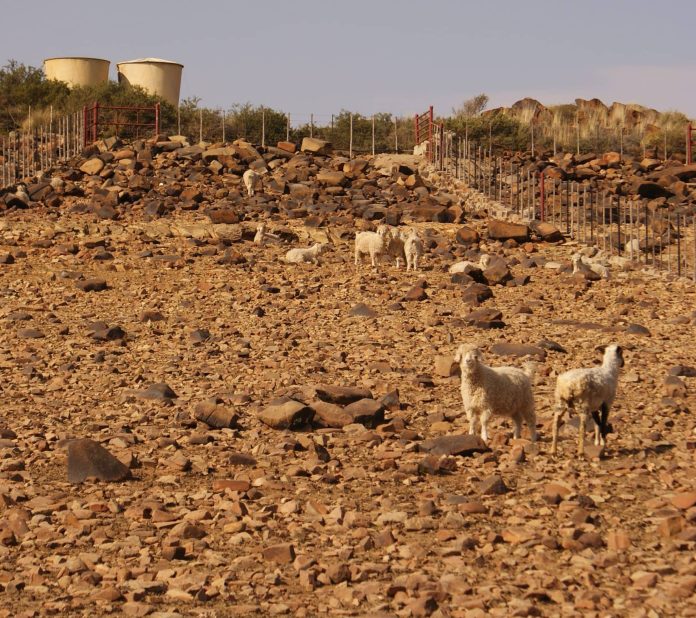
The Central Karoo’s livestock numbers shrank by more than a third during the drought – the figures represent 44 farms comprising 420 000ha. This is a reliable estimate, as figures for 82% of the group are available – a decade’s worth of figures for another 14% of the members and at least nine years’ worth of data for the remaining 5% of the group. Producers excluded from the group are those who sold their farms, died or retired. The figures only apply to people who continued to farm throughout the drought.
The region’s stocking rate peaked in 2014, averaging around 84% of the departmental norm. The stocking rate was marginally lower (82,2%) during the four-year period from 2012 to 2015, and the effects of the drought only emerged after that.
This group of producers’ stocking rate is therefore typically around 18% below the norm, which may be higher than is generally accepted. The typical one-third stocking rate reduction kicked in much later and by 2022 there were still no signs of recovery. The latter is based on preliminary data that still needs to be verified.
Read more about Drought lessons from the Kalahari.
Figure 2: Breeding animals and wethers/castrated goats in the Central Karoo. (Source: Karoo Management Panel [KMP] dataset)

Meat and fibre production
Dorpers made up the majority of the Central Karoo flock before the drought, totalling approximately 22 000 young and breeding ewes. By 2017, the group’s Dorper numbers had declined dramatically to just over 10 400, and by 2021 there were only 5 000 Dorper ewes remaining across the 420 000ha area. Meatmasters are now replacing Dorpers. The group’s Meatmaster numbers have increased from 1 400 breeding and young ewes to over 5 000.
Together, Dorpers and Meatmasters have shown a moderate decline of approximately 28% by 2017, followed by a 50% loss in numbers since 2019. The region’s Boer goat numbers are small but stable.
There were 16 600 wool sheep in the group, mainly Merinos, with Dohne and Afrino sheep in a few flocks here and there. In addition to breeding and young ewes, the number also includes rams. The wool producers in the group managed to maintain their numbers until 2017; and after that the average reduction of animals was in line with the recommended one-third reduction. Despite a high degree of resilience, wool producers showed no signs of recovery.
There were also just over 7 000 Angoras, generally more towards Beaufort West where conditions were for the most part better than in Laingsburg. The drought had almost no impact on Angora numbers.
Read more about Drought management skills a must for SA producers.
Numbers in historical context
Reliable agricultural figures are rare these days. In 2020, a census was published for the first time in 13 years (there were concerns regarding the previous two). Scaling the 12% of the region whose figures appear in Figure 2 to 100%, the Central Karoo would have had an estimated 339 000 sheep and goats in 2017. Of these, the census showed 96%, which greatly restores confidence in the remainder of the figures. That is the good news.
Table 1: Livestock numbers for the Central Karoo: census vs KMP data (thousands).
| Year | Stats SA census figures | Regional figures according to KMP data |
| 1960 | 1 219 | |
| 1971 | 860 | |
| 1981 | 902 | |
| 1988 | 795 | |
| 1993 | 590 | |
| 2002 | 352 | |
| 2007 | 555 | |
| 2012 | 353 | |
| 2013 | 386 | |
| 2014 | 432 | |
| 2015 | 401 | |
| 2016 | 355 | |
| 2017 | 327 | 339 |
| 2018 | 254 | |
| 2019 | 223 | |
| 2020 | 216 | |
| 2021 | 200 | |
| 2022 | 186* |
The bad news is that the Central Karoo has lost a great deal of its historical carrying capacity. We do not know exactly when this happened. According to Statistics SA’s official livestock figures, between 1950 and 1965 there were more than a million sheep, mostly Merinos, in the Central Karoo. There weren’t a lot of goats at that time (approximately 60 000) and only a handful of Angoras. The stock removal scheme of the late 1960s reduced livestock numbers by a third to 815 000 sheep and 45 000 goats in 1971. This level was maintained until 1988.
In 1993, according to the census, the region had only 590 000 sheep and goats, but we know that the 1993 census was conducted at an inconvenient time and that this might have led to the underreporting of numbers. The 2002 census was not a success, and the figure of 555 000 small stock recorded in 2007 is more in line with the long-term trend. The KMP group’s figures indicate a sheep population of 350 000 and a goat population of 400 000 in the Central Karoo by 2010 – this number declined by half to between 200 000 and 220 000 during the drought.
Most commercial producers are optimistic about the possibility of recovery. It does, however, take longer than one would think, which gives the veld a chance to recover before livestock numbers increase once more. – Beatrice Conradie, University of Cape Town
For more information and enquiries, send an email to beatrice.conradie@uct.ac.za. This research was funded by Red Meat Research and Development South Africa (RMRDSA), an umbrella body mandated to conduct research and development under the auspices of the Red Meat Industry Forum (RMIF). For more information, visit www.meatindustrytrust.co.za.
