
Estimated reading time: 6 minutes
Rooibos (Aspalathus linearis) is an indigenous South African plant, endemic to a narrow ecological zone in the Cederberg and surrounding areas of the Western and Northern Cape.
Long before commercialisation, rooibos was an integral part of Khoisan culture, diet, and traditional medicine. Wild shrubs were harvested, the leaves bruised with stones, naturally fermented and sun‑dried to produce a naturally sweet, caffeine‑free infusion, used both as beverage and a remedy.
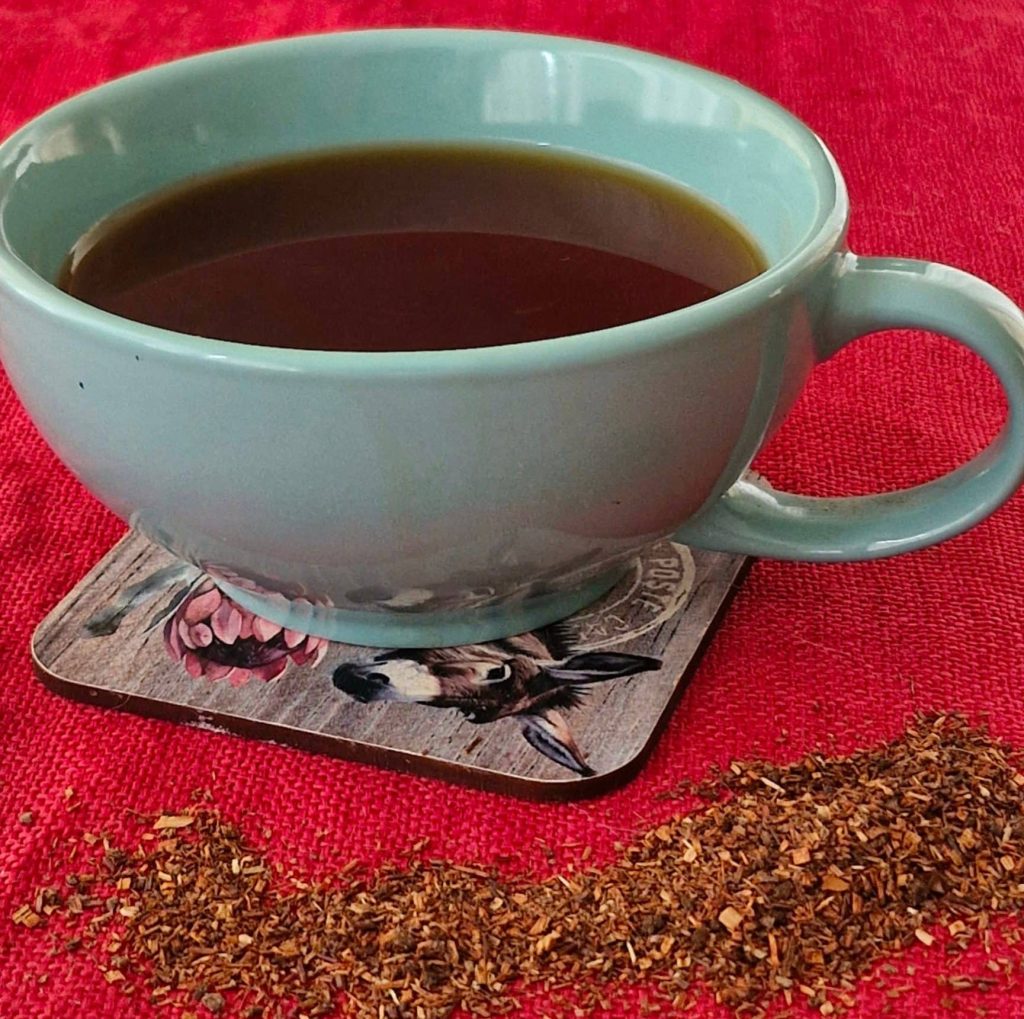
European botanists first recorded rooibos in the 18th century, but for more than 100 years it remained a wild‑harvested product rather than a cultivated crop. In a transition during the 1920s, rooibos was already sold locally as a substitute for black tea, and organised farming started to emerge. A turning point came in the 1930s, when Dr Pieter le Fras Nortier successfully developed reliable seed‑germination techniques, enabling systematic cultivation and laying the foundation for formal production in the Cederberg and adjacent areas. Early production was marked by high price volatility, reflecting limited agronomic knowledge and unstable supply. World War II proved decisive for the industry: Disruptions to Asian black tea imports heightened domestic demand, establishing rooibos as a national beverage in South African households.
In response to price instability and supply challenges, government introduced the Rooibos Tea Control Scheme in 1954, establishing a single‑channel marketing monopoly. For nearly four decades, this system stabilised prices and volumes, provided some research and extension services and maintained consistent quality standards. However, while it created stability, the value chain excluded black producers, reflecting the inequities of apartheid. Despite these limitations, exports to Europe and Japan grew from the 1970s onwards, introducing rooibos to an international consumer base.
Deregulation via the abolition of the control board in 1993 fundamentally reshaped the industry. Market liberalisation enabled the entry of private processors and exporters, the emergence of value‑added branding and rapid export-led expansion. By the early 2000s, exports exceeded 5 000 tonnes annually, with Germany, the Netherlands, the UK, and Japan emerging as dominant markets. Rooibos became a firmly established niche health product in global herbal tea markets. Land under production expanded sharply, from approximately 13 000 hectares in 1993 to more than 56 000 hectares by 2019, driven by export demand and growing consumer interest in health‑oriented beverages. Rooibos is typically produced in a rotational system with small grains such as oats, rye or barley, or a combination of these, with lupins as fodder. The roughly 56 000 hectares under production, constitutes about 60% of the hectarage used for rooibos, with another 25 to 30 000 hectares typically under rotation with these crops.
Rising export volumes—particularly to Japan—alongside expansion into cosmetics, nutraceuticals, and functional foods resulted in a substantial increase in export value, from R201 million in 2001 to approximately R936 million in 2019. The sector became increasingly export‑driven, while domestic consumption remained relatively stable. In May 2021, the industry achieved a landmark regulatory milestone when the European Union granted Protected Designation of Origin (PDO) status to Rooibos. This designation provides legal protection against imitation, enables premium price positioning, and confirms the geographic and cultural specificity of rooibos. As the first African agricultural product to receive EU PDO recognition, the designation strengthens its global reputation and long‑term market positioning.
Production systems are typically ecologically diverse. Wild rooibos exists in multiple ecotypes, each adapted to different soil types, altitudes, and microclimates within the Cederberg. These ecotypes differ in water‑use efficiency, growth form and resilience. As a result, rooibos products may originate from up to 14 distinct geographic regions, either wild‑harvested or cultivated under different farming models. Protection of genetic diversity is critical, both to prevent erosion and to support future climate adaptation and breeding programmes.
Rooibos is most often produced within mixed farming systems alongside citrus, grains, vegetables, and sheep. Approximately 50% of total production originates from marginal or mixed‑use land, with the other 50% from specialised rooibos producers.
Annual output fluctuates between 13 000 and 18 000 tonnes, influenced by rainfall and climate conditions. Typically, production levels vary between 300 and 450kg of dry tea per hectare, depending on the natural resource and management level. Higher production levels (up to 600kg per hectare) are no longer common, likely due to declining soil fertility resulting from unsustainable cultivation practices.
Last year, production was approximately 18 000 tonnes, following several drought‑affected seasons. This included roughly R11 000 tons exported, and 7 000 tons sold locally. The local market has contracted substantially over the past decade, likely due to economic pressures on consumers, specifically in main user areas such as rural Limpopo and Mpumalanga. There is also concern that whilst farm gate prices have recently declined, shelf prices remain relatively high.
The industry employs approximately 8 000 workers. Export volumes reached approximately 9 700 tonnes in 2024. Rooibos is now exported to more than 50 countries with key markets including Japan, Germany, Netherlands, the UK and France. The reduction of import tariffs into China—from roughly 30% to 6% in 2024—has further strengthened growth prospects in Asian markets.
Domestic and export markets are roughly similar in size, although domestic demand has remained relatively flat while export demand increased by around 20% last year. Rooibos prices typically ranged between R25/kg and R45/kg last year, although historically prices have exceeded these levels by as much as tenfold in periods of tight global supply. However, the industry has identified price stability as a key strategic objective, as predictability supports long‑term contracts and market confidence. Historic price fluctuations of up to 80% are not appreciated under typical global market conditions and stable prices are in the interest of producers, processors, and marketers in the value chain.
Key challenges include climate variability, yield and price volatility, land reform and equity concerns and cost pressure on primary producers. Opportunities for the industry include continued global health and wellness trends, potential Asian market expansion, PDO‑based premiumisation and growing demand in cosmetic and functional food use.
Rooibos is a unique example of an indigenous African plant that has been transformed into a globally recognised export commodity, while remaining geographically and culturally anchored in South Africa. It is both a significant economic asset and a symbol of cultural heritage. With continued climate adaptation, equitable value‑chain participation, and strategic market development, rooibos is well positioned to remain a resilient and emblematic South African export in the decades ahead. – Dr Aart-Jan Verschoor, Senior Manager – Agrimetics
For more information, contact Dr Aart-Jan Verschoor on 084 505 3627 or 012 427 9866.
