
Estimated reading time: 5 minutes
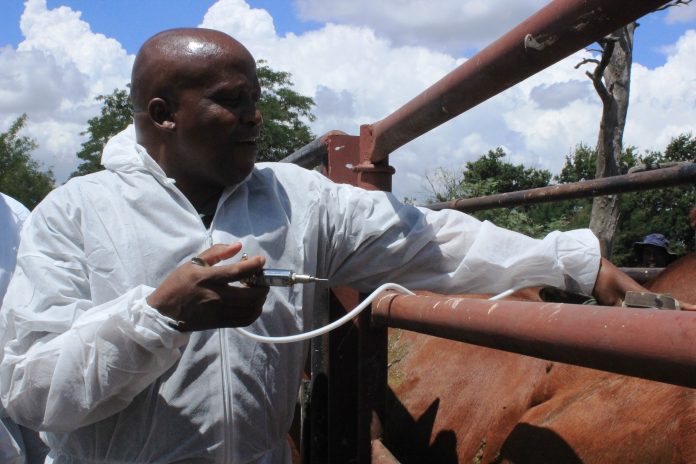
The North West Department of Agriculture and Rural Development is intensifying efforts to combat foot-and-mouth disease (FMD), marking a major milestone with the new vaccine supplies. MEC Madoda Sambatha launched the province’s vaccination rollout strategy on 4 February at the Potchefstroom College of Agriculture. During a media briefing, followed by the vaccination of cattle at the department’s Machavie Experimental Farm, Sambatha provided an update on the disease’s status and outlined the province’s vaccination strategy. He reassured farmers that vaccine supplies have arrived and will be distributed fairly.
The province received 100 000 doses of the Bioaftogen vaccine on 21 February, which is part of a total order of one million doses supplied by Biogénesis Bagó in Argentina. He explained that the vaccination strategy targets farms and villages within a 5km radius of confirmed cases, prioritising at-risk cattle. This approach supports the national objective of vaccinating 90% of the cattle population, with coverage expanding as more doses arrive.
Additionally, 1 400 doses produced by the Agricultural Research Council (ARC) arrived on 9 February and were used on a dairy herd in Bojanala Platinum District Municipality and recorded in the Livestock Identification Traceability System (LITS). Daily vaccinations will continue as long as doses are available, targeting both formal farms and communal areas for balanced coverage. Regular vaccine consignments are expected, including part of a 1,5 million Dollvet dose shipment from Turkey, which arrived at OR Tambo International Airport on 28 February to expand coverage.
Affected areas
Sambatha confirmed FMD is actively spreading across farms and villages, with most newly reported cases showing lesions less than five days old. Out of the province’s 18 municipalities, 16 have been affected, with 158 confirmed cases: 155 in cattle, two in pigs, and one in a goat.
The Dr Kenneth Kaunda District Municipality has the highest number of cases, particularly in Ventersdorp and Potchefstroom (JB Marks Local Municipality). The Bojanala Platinum District Municipality ranks second, with Rustenburg, Madibeng, and Kgetleng River as key hotspots. These two districts form the outbreak epicentres and require urgent vaccination. The Dr Ruth Segomotsi Mompati District Municipality is third most affected, while Ngaka Modiri Molema District Municipality has fewer cases.
Sambatha added that South Africa has approximately 14 million head of cattle, of which 1,4 million are in the North West, making it the fourth-largest cattle-producing province nationally. If two rounds of vaccination are required, North West will need about 2,8 million doses. Vaccine allocation is based on infection levels, and since the North West accounts for about 5% of national infections, provinces with higher case numbers – such as KwaZulu‑Natal and Gauteng – will receive a larger proportion of the available vaccines.
Risk-based distribution
Dr Langa Madyibi, director of veterinary services in the North West, explained that the limited Argentinian vaccine consignment will be distributed based on a risk-based approach. Outbreaks have been recorded across all four districts, with pockets of infection in each, so vaccine efforts will prioritise areas where the virus is actively circulating.
High-risk areas include farms with active FMD cases, including those identified as recently as 27 February. Dairy farms and farms near buffalo – known to carry and transmit the virus without symptoms – are also high risk. Vaccinating these areas helps reduce viral load, limit transmission, and create protective barriers.
Dr Madyibi further noted that the border area between North West and Northern Cape has long been regarded as a high-risk zone, even before FMD cases were reported in the Northern Cape and therefore requires joint vaccination efforts. Regarding the spread to Botswana, he confirmed no cases have spread to farms near the border. However, recent outbreaks have moved toward the western border near Bray. These farms are under state control, and while no spill-over into Botswana has been reported, the situation could still change.
Vaccination in communal areas
Dr Madyibi said villages are a key focus in the fight against FMD, as communal farming practices often lack biosecurity measures such as fencing, leaving animals vulnerable to virus spread. Animals from these areas frequently pass through auctions before being transported to backgrounding farms and feedlots. By vaccinating cattle in these communities, the department aims to build herd immunity and break the transmission chain.
Communal areas where outbreaks have occurred are under quarantine and prioritised for vaccination. The strategy is to start in these areas to disrupt the infection chain. The department is working with farmer organisations and local traditional leaders to share information and co-ordinate efforts. Vaccination points are set up in these areas, with mobile units deployed where infrastructure is limited.
Tagging of animals
According to Dr Madyibi, vaccinated animals will be tagged for traceability. Scanning and tagging equipment will be provided during the vaccination process, especially in communal areas. “We’ve procured equipment for tagging, which will help when we return for booster doses.” Tagged animals will be recorded on the Livestock Identification Traceability System (LITS), allowing authorities to track their origin and vaccination status throughout their lives. This system applies to both communal and commercial farmers, as all vaccinated animals must be individually identified.
Private veterinarians
Private veterinarians across the province have applied to assist with pre-emptive vaccination of healthy animals for farmers they work for. These veterinarians must first be authorised by a local state veterinarian and then approved by the director of veterinary services. Once authorised, they can oversee vaccination of their clients’ animals under state-controlled disease protocols. For pre-emptive vaccinations farmers must complete an application form, recommended by a state veterinarian and approved by the director, to access pre-emptive vaccines, which are then distributed through state channels.

Preventing the spread
Dr Madyibi said control measures aim to prevent FMD spread, with quarantine being one of the most effective interventions as it isolates infected animals. He urged farmers to immediately report any suspected FMD symptoms to their nearest veterinary clinic or extension officer, and to avoid moving any livestock that may be infected. Prompt reporting enables veterinary services to track outbreaks more accurately and determine where vaccines are most urgently needed.
Meanwhile agriculture minister John Steenhuisen, visited Bloemfontein on 2 March to support the Free State’s FMD disease vaccination rollout. – Christal-Lize Muller, Plaas Media.
