Estimated reading time: 7 minutes
The future success of the mohair industry will depend on its ability to combine exceptional fibre quality with verifiable sustainability, traceability, and strong market engagement.
The 2026 Mohair South Africa (MSA) Conference held in Graaff-Reinet recently, focussed on three pillars: sustainability, traceability, and future growth. Together, these set the tone for proactive value creation and long-term viability.
This year’s two-day gathering brought together producers, processors, marketers, and industry stakeholders to reflect on the sector’s achievements and chart a course for future growth. The programme focussed on industry opportunities and challenges, while speakers highlighted the resilience, innovation, and adaptability of mohair producers, as well as the importance of collaboration across the value chain.
Excellence in production recognised
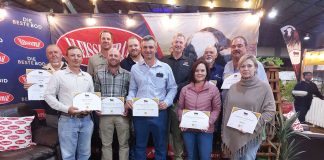
One of the event highlights was the celebration of excellence in super kid mohair production for the 2026 summer season, alongside the Mohair Excellence Awards. The awards recognise producers who set the benchmark for fibre quality while embracing responsible production practices. Introduced in 2025, they celebrate producers whose commitment to excellence strengthens South Africa’s position as the world’s leading supplier of premium mohair.
This year’s top five producers in the super summer kid mohair production category were:
- Bobby-Luke Colborne (FEC Farming/OVK).
- Michau Nortje (JPM Nortje/The House of Fibre).
- Jordi van Hasselt and Jean Windvogel (Van Hasselt Farming CC/The House of Fibre).
- Paul Webber and Martin Lombaart (PF Webber/OVK).
- Schalk Nel and Andreas Nel (Slater Nel/The House of Fibre).
The winners shared a prize pool of R110 000, sponsored by the South African Wool and Mohair Buyers Association (SAWAMBA).

Industry embraces data-driven decision-making
MSA also announced the launch of a new study group, set to commence on 1 July 2026. Facilitated by Dr Louis du Pisani and the Pinion SA Group, the initiative will involve volunteer farmers sharing production and financial data to support benchmarking, identify opportunities for improvement, and strengthen decision-making across the industry.
The project forms part of a broader shift towards evidence-based management and measurable outcomes, a trend that featured prominently throughout the conference.
From marketing to measurable sustainability
Lindsay Humphreys, independent strategic advisor to MSA, said the mohair industry had moved from pure marketing towards sustainability and science over the past few years. She added that the current challenge lies in translating on-farm practices into measurable indicators that brands and consumers can trust.
This ‘missing middle’ between farm-level activities and market expectations is increasingly important as global brands demand verifiable environmental, social, and animal-welfare credentials.
To address this, the industry is strengthening collaboration with brands through initiatives such as the Mohair Collective, which promotes co-investment, transparency, and data-driven partnerships throughout the supply chain.

Strong market performance
Delegates heard that market conditions remain encouraging, with strong competition at auctions and record prices achieved for fine clips. South Africa continues to dominate global mohair production, accounting for approximately 58% of world output, while Southern Africa contributes almost three-quarters of global production. China remains the largest destination for South African mohair exports, purchasing 53%, followed by Italy at 26%.
Earlier this year, a world-record auction price of R1 330/kg for a premium clip of South African mohair highlighted the value placed on exceptional quality, while certification continued to provide a measurable advantage in the marketplace.
Responsible Mohair Standard (RMS)-certified mohair fetched an average premium of nearly 10% over non-certified fibre, demonstrating the growing commercial value of verified sustainability credentials.
Sustainability and environmental measurement
Environmental performance and life-cycle assessments (LCA) received considerable attention during the conference. Two independent studies were presented, both aimed at quantifying the environmental footprint of mohair production. While the studies produced different results due to varying methodologies and system boundaries, both identified methane emissions and land use as the primary contributors to mohair’s carbon footprint.
Future work will focus on obtaining direct methane measurements from South African production systems and exploring the application of the ISO 14067 Biogenic Carbon Standard. These initiatives are expected to improve the accuracy and credibility of environmental reporting, particularly in export markets where sustainability requirements continue to increase. The core message was that robust scientific evidence will be essential to support mohair’s position as a natural, renewable, and biodegradable fibre in an increasingly regulated global marketplace.
Building a traceable and trusted value chain
Several presentations underscored the growing importance of traceability, transparency, and consumer trust, emphasising that modern buyers increasingly require proof rather than promises. Certifications, audited supply chains, and documented environmental performance are therefore becoming standard expectations, particularly in European markets.
The message throughout the conference was clear: Fibre quality alone is no longer enough. Consumers and brands want to understand where products come from, how they were produced, and what impact they have on people, animals, and the environment.
Industry stakeholders also discussed emerging opportunities linked to digital product passports, regenerative agriculture, and collaborative sustainability projects that can attract international investment.
The role of the RMS was, once again, highlighted as crucial to safeguarding animal welfare and industry credibility. With approximately 85% of auctioned mohair now RMS certified, the industry continues to invest in independent audits and veterinary inspections to ensure compliance. Producers were also encouraged to exercise caution on social media, recognising that reputational risks can spread rapidly in a digitally connected world.
Empowering emerging producers
Established in 2010, the Mohair Empowerment Trust has become a powerful success story in agricultural development. It offers interest-free financing and mentorship to help emerging Angora producers establish commercially viable enterprises. Through a structured five-year model, participants receive support to develop their operations before taking full ownership of the assets and enterprises created through the programme.

Leadership and looking ahead
Pierre van der Vyver’s departure comes on the heels of a landmark achievement for the South African mohair sector, with local producers setting a new world-record price for three premium mohair bales during the 2026 season. He has led the organisation as chief executive officer for the past seven years, helping to strengthen South Africa’s position as a global leader in mohair production and marketing. He will, however, remain involved in an advisory capacity while day-to-day management transitions to Roché Jongkind, Elrin Davids, and Petrie Maré.
As the conference concluded, the industry’s strategic priorities became increasingly clear: strengthening sustainability credentials, improving environmental measurement, expanding market development efforts, enhancing traceability, and maintaining the trust of consumers and international buyers.
While challenges remain, delegates left with a shared sense of confidence that the South African mohair industry is well positioned to build on its reputation for quality while adapting to the demands of a rapidly evolving global marketplace.

For more information, contact Lauren Moore on 041 581 1681 or lauren@mohair.co.za – Carin Venter, Plaas Media