

Estimated reading time: 6 minutes
“It’s like speed dating on steroids.” This tongue-in-cheek remark by Debbie Bester, CEO of Senwes, was perhaps the most accurate summary of Agri SA’s ATLAS conference, which took place at the Choose Life Church in Moreleta Park, Pretoria, last week. A hundred speakers had the opportunity to express themselves within the span of eight hours.
This included a diversity of opinions; farmers, agribusinesses, retailers, parastatals, government, organised agriculture, business leaders, and communications experts all gave their inputs, which left the audience overwhelmed and struck by how many others carry similar burdens to their own.
Economic revolt against corruption
The first speaker for the day was Busi Mavuso, non-executive director of Business Unity South Africa (Busa). She emphasised the need for decisive, structural reforms to ensure that South Africa’s economy is de-risked from politics. “Politics and the economy are two sides of the same coin. If you have the wrong politicians leading the country, the economy will fail.”
Mavuso said this was evident during the Zuma administration, and she emphasised the fact that politicians should never again have access to so many funds. That is why it is critical that the monopolies of parastatals, such as Eskom, are broken through privatisation. “All of our state-owned enterprises are dysfunctional,” she said, adding that they are rendered ineffective due to political interference. “Our country should never suffer the way we suffered (during the Zuma era).”
The director-general for the National Department of Agriculture, Mooketsa Ramasodi, followed Mavuso, saying that we should not forget about the progress that has been made in the country, especially in the agricultural sector. He stated that the sector’s output has more than doubled since 1994 and that the industry’s GDP for last year amounted to US$13,7 billion. “We made these gains over time,” Ramasodi said, adding that the liberalisation of the sector around 1996 was one of the biggest reasons for the improvement.
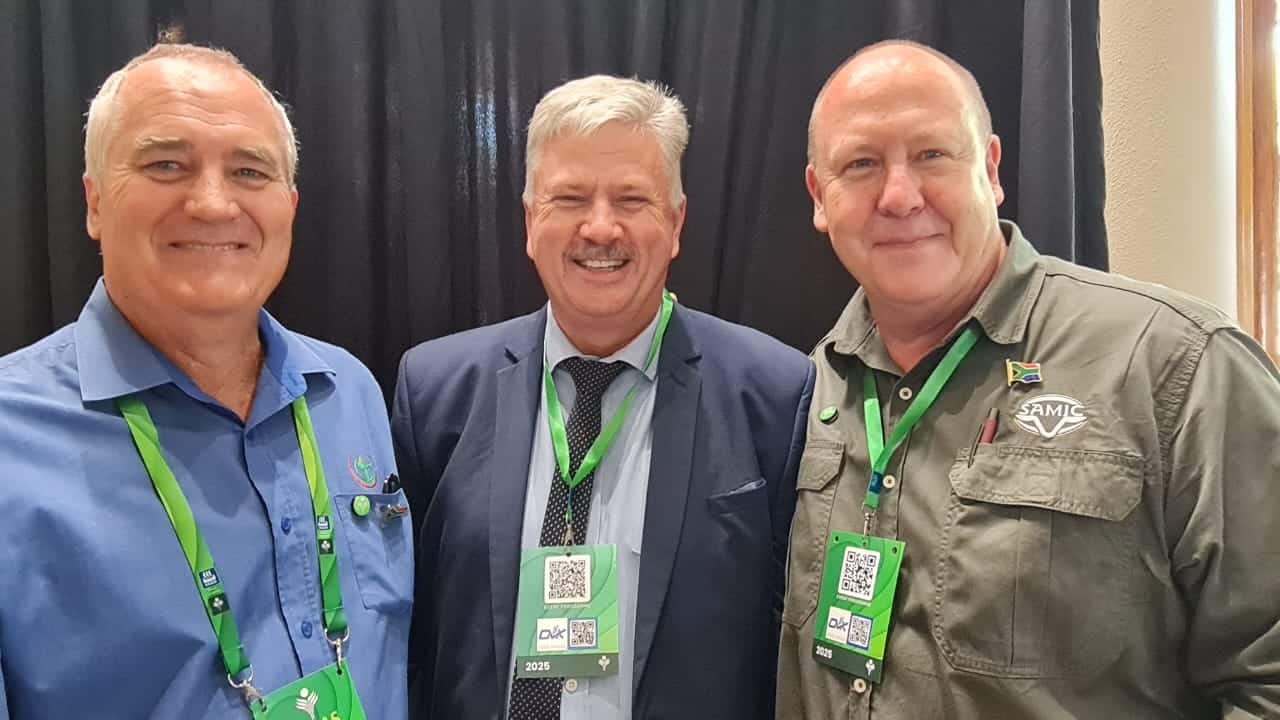 Douw Pelser, member of Agri Limpopo and chairperson of RPO Limpopo, Francois Knowles, registrar of Agricultural Produce Agents Council (Apac), and Tom Westphal, CEO of South African Meat Industry Company (Samic).


Climate change
Agri SA’s newly elected chairperson, Willem de Chavonnes-Vrugt, was the first person to fire a climate-related shot for the day when he commented on the onus resting on farmers’ shoulders with regard to carbon emissions. “Agri SA supports the Paris agreement, but agriculture cannot be the only party responsible for achieving unrealistic carbon footprint expectations.” He added that serious water quality concerns need to be addressed and that better financing options are crucial to producers’ ability to mitigate the future challenges of climate change.
Richard Krige, chairperson of Agri SA, said while adaptable financing models are important, title deeds remain a burning need for South Africa’s farmers. “The fact remains that title deeds are not being transferred quickly enough, and this hampers farmers’ ability to gain access to financing.”
Enrico Brandt, the deputy ambassador of Germany, expressed his country’s desire to build better ties of cooperation with South Africa to combat climate change, since this issue would have an impact on the prosperity of future generations. “Germany is experiencing climate change first-hand and to address this, the country aims to be climate neutral by 2045,” Brandt said, adding that 56% of all of Germany’s energy consumption is already sourced from renewable energy sources.
While looking towards the future is great, Dr Tobias Doyer, CEO of Grain SA, reminded the audience of the past. He said there were farmers in the room who had achieved an incredible feat during their lifetimes as farmers by decreasing the chemicals they use on the farm by 80%, while increasing yields by over 400%. “This shows the incredible power of regenerative agriculture. It is something that we must use even more going forward.”
Biosecurity
The session on biosecurity focussed on the fact that people, goods, and animals are moving more freely across the globe, which increases the risk for the spread of pests and diseases. While advances in technology and greater awareness have enabled earlier detection and have enabled a more precise management of outbreaks, various speakers highlighted the serious challenges that continue to threaten entire value chains.
Dr Matthys Uys, a veterinarian at Woolworths, highlighted the fragile trust relationship between consumers, retailers, and farmers. Once there is a breakdown in biosecurity and health is threatened, it causes a breakdown in trust that takes an extremely long time to repair.
Isak Staats, BKB’s executive manager for wool and mohair, said over the past five years his division experienced two outbreaks of foot-and-mouth disease (FMD). This meant that they could not do any business for many months – first for six months and then for three months. “In the wool industry there are no half measures. We need robust industry bodies that can speak on our behalf, because the government does not speak to individual businesses. They will only speak to industry bodies.”
Richard York, CEO of Wildlife Ranching South Africa (WRSA), highlighted an interesting shift that had occurred. “In the past, we often heard about wildlife contaminating domestic farm animals. Now we’ve seen this change.” He added that this cross-contamination is one of the reasons why the industry can no longer afford to operate in silos.
Dewald Olivier, executive director of the Red Meat Industry Services (RMIS), agreed that the industry is still largely operating in silos – even though it’s not as rigid as it was in the past. “Biosecurity essentially boils down to good governance. We can have the best rules, but if we don’t apply them, they don’t mean anything.”
Douw Pelser, chairperson of the Red Meat Producers’ Organisation in Limpopo (RPO Limpopo), said the dedication of Limpopo’s state veterinary services made a big difference in keeping FMD at bay in that province. Over the past six years, 600 000 animals have been vaccinated. Other parties, such as auction houses, also play an incredible role in ensuring that the province remains FMD-free – outside the red zone. However, the illegal smuggling of animals remains a massive concern that needs to be addressed more firmly, Pelser mentioned.
Dr Mike Modisane, chief director of Animal Health and Production at the National Department of Agriculture, said that although biosecurity is everybody’s business, it is critical to keep in mind that the first line of defence is on the farm.
Artificial Intelligence (AI) noise
The last session of the day focussed on the harmful impact of Generative AI that’s made with the sole aim of providing false or misleading content, which can be produced and distributed at scale.
Karen Allen, a former BBC journalist and founder of Karen Allen International, spoke about the dangers of deepfake videos created with the help of artificial intelligence, as well as the fact that computer algorithms tend to prioritise popular content over newsworthy information that people need to read.
While it is good news that laws surrounding the use of AI to create deep fake media are becoming stricter, it is still not secure, and people need to be wary of messages on social media – especially when it comes to sharing a message. She referred to “useful idiots” who share social media messages without considering the unintended consequences of their actions.
Marianne Tham, assistant editor of the Daily Maverick, said that while everybody might not like what journalists write, at least a journalist is a person who can be sued and held accountable should they spread lies. She highlighted the fact that AI content is wreaking havoc on the news industry, especially in today’s attention-driven economy. – Susan Marais, Plaas Media
