Estimated reading time: 7 minutes
Today the minister of agriculture, John Steenhuisen, communicated the foot-and-mouth disease (FMD) response plan and the task team to oversee its implementation. Alongside some much-needed good news, he once again stressed compliance with legislation and biosecurity protocols and urged livestock farmers to cooperate fully.
“The FMD situation in our country remains a matter of great concern, with far-reaching consequences for government, industry, and most crucially, for the farmers affected by both the disease and the control measures imposed to contain it. I wish to update all role-players on the current status of FMD outbreaks in South Africa, beginning with some good news.
“I am pleased to report that the outbreaks which afflicted Eastern Cape in 2024 have not resurfaced in 2025. The last outbreak in Eastern Cape occurred in September 2024. Following extensive surveillance in and around the affected areas, the disease management area (DMA) was lifted on 4 July 2025. The affected farms in the Humansdorp and East London areas remain under quarantine, following the lifting of restrictions, and are undergoing final testing to confirm the absence of the FMD virus. The results to date, are encouraging.
“I wish to express my gratitude to every individual and institution who contributed to resolving these outbreaks. Farmers adhered to quarantine conditions despite the hardship this imposed; Agri Eastern Cape supported government in monitoring livestock movements into and out of the affected areas; and veterinary services officials worked tirelessly to meet regulatory requirements. This success story was made possible through dedication and partnership.
“Equally encouraging is the situation in Limpopo, where all outbreaks were resolved in August 2023. The DMA in Limpopo was also rescinded on 4 July 2025.”
Northern Cape and Western Cape unaffected
“The Northern Cape and Western Cape remain FMD-free, with no cases detected and no animals vaccinated. Veterinary services in these provinces continue to be vigilant, however, their success depends heavily on livestock owners adhering to movement restrictions and biosecurity requirements. Infection is most often spread through livestock movement, and producers must play their part in keeping these provinces safe.”
Outbreaks this year
“It is important to note that for the current financial year we procured 900 000 doses of vaccine to the value of R72 million from the Botswana Vaccine Institute. The first 500 000 doses arrived in June and were used to vaccinate cattle in Kwazulu-Natal, Mpumalanga, Limpopo, Gauteng, North West, and Free State. Just over a week ago, we received the remaining 400 000 doses of which 50 000 are already distributed. The remaining doses of the vaccine will go to areas currently experiencing outbreaks – these include the Free State, Mpumalanga, North West, and Gauteng.
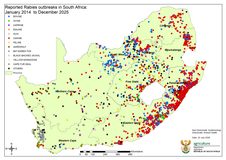
“Now let us delve into the outbreaks this year. At the beginning of 2025, active FMD outbreaks were confined to KwaZulu-Natal. Unfortunately, by the end of May 2025, new outbreaks had emerged in other provinces. At present, there are 274 unresolved outbreaks across KwaZulu-Natal, Gauteng, Free State, North West, and Mpumalanga. Positive cases have been confirmed in all cattle farming systems – commercial beef herds, animal breeding, feedlots, dairy cattle, and communal herds.
“In KwaZulu-Natal, the outbreaks have continued to spread westward, with confirmed cases in the Dundee, Dannhauser, Newcastle, Alfred Duma, Okhahlamba, uMshwathi, eDumbe, and uMshwathi local municipalities. Fortunately, the disease appears to have abated in the eastern part of the DMA, though 180 outbreaks remain open in the province.
“The virus spread from KwaZulu-Natal into Mpumalanga through an auction in February 2025. By late May 2025, additional outbreaks were reported in Gauteng, North West, western Mpumalanga, and the Free State. Investigations suggest both farm-to-farm spread, and “pinpoint” introductions associated with livestock movements where isolation protocols were not observed as contributors to the spread of the disease. Current numbers are as follows: Gauteng: 54 outbreaks; North West: 26; Mpumalanga: 9; and Free State: 5.”
Bosberaad brings new era
“On 21 and 22 July 2025, the National Department of Agriculture (NDA) in collaboration with the Agricultural Research Council (ARC), convened a Bosberaad under the theme: “Building a resilient system to fight foot and mouth disease”. Over 400 stakeholders from government, academia, industry, and research institutions participated.
“In my keynote address, I highlighted that current approaches are fragmented and lack sufficient enforcement and coordination, contributing to the persistence of outbreaks. Measures proposed include revising control zones, expanding capacity for sampling and diagnostics, and increasing access to vaccines. In the short term, additional vaccine doses will be imported from Botswana while South Africa scales up its own production. A mid-scale vaccine facility with a capacity of 150 000 to 200 000 doses per year is on track for commissioning in March 2026.
“Stakeholders also underscored the crucial role of livestock identification and traceability systems in enforcing biosecurity. Without such systems, containment measures will remain compromised.
“The following three options were debated:
- Declaring FMD endemic across the country. (Rejected owing to severe economic and trade consequences.)
- Maintaining and strengthening current controls. (Feasible but resource-intensive.)
- Adopting the Progressive Control Pathway (PCP) to gradually regain FMD-free status.
“The Bosberaad recommended a phased, multidisciplinary approach, combining stronger existing controls with the PCP framework. This will be underpinned by legal reform, domestic vaccine production, improved diagnostics, livestock identification systems, and collaborative governance.
“Immediate actions include scaling up vaccine production, accelerating livestock identification, expanding diagnostic capacity, and intensifying awareness campaigns. Medium to long-term priorities include infrastructure investment, regional cooperation, and sustained funding for veterinary services and research.
“Research gaps remain, particularly around buffaloes as carriers and Southern African Territories (SAT) strains. Questions such as the feasibility of buffalo vaccination also require further study.
“Key minimum measures identified include the following:
- Unifying FMD protocols under a national plan.
- Rebuilding vaccine production capacity and training skilled staff.
- Deploying rapid tests in the field and reducing lab turnaround times.
- Expanding animal identification systems to regional benchmarks.
- Strengthening research on local strains and post-vaccination immunity.
- Securing sustainable funding across the value chain.
- Reassessing outdated or unsupported policies, such as fifth quarter disposal.”
Industry-government task team
As I pledged at the Bosberaad, an industry-government task team on animal disease prevention, management, and control will now be established.
Government will be represented by:
- Dr Emily Mogajane – chief director: Biosecurity Coordination (chairperson and convener).
- Dr Botlhe Modisane – chief director: Animal Health and Production, NDA.
- Dr Nomsa Mnisi – director: Biosecurity Support Services, NDA.
- Dr Themba Sikhakhane – chief director: Veterinary Services, KwaZulu-Natal.
- Dr Bheki Cele – chief director: Veterinary Services, Mpumalanga.
- Dr Wynton Rabolao – director: Veterinary Services, Gauteng.
- Dr Baratang Lubisi – research team manager, ARC.
- Dr Moses Mabunda – director: Veterinary Services, Limpopo.
- Dr Marietta Swanepoel – deputy director: Secretariat Support.
- Dr Oseke Ngoveni – state secretariat support.
Additional provincial veterinarians will be included as required.
The Red Meat Industry Services (RMIS) has nominated the following veterinarians to represent the industry:
- Prof Dietmar Holm – University of Pretoria, bovine herd health (academic/beef).
- Dr Dirk Verwoerd – specialist in infectious diseases of intensive production systems, with emphasis on vaccine development, surveillance, and diagnostics.
- Dr Jacque Marais – dairy industry.
- Dr Anthony Davis – milk processors.
- Dr Adriaan Olivier – ostrich industry.
- Dr Amanda Botes – specialist in FMD and African Swine Fever (ASF) diagnostics and molecular epidemiology.
- Dr Mark Chimes – dairy, chairperson of the Brucellosis and Tuberculosis Steering Committee.
- Dr Pieter Evans – specialist in eradication of PRRS and ASF outbreak management.
- Dr Shaun Morris – feedlot specialist.
- Dr Baty Dungu – member of the World Organisation for Animal Health (WOAH) Scientific Commission, African Union Pan African Veterinary Vaccine Centre (AU PANVAC) Steering Committee, and African Union-Interafrican Bureau for Animal Resources (AU-IBAR) expert panel on animal health and disease control.
- Dr Danie Odendaal – ruminant veterinarian specialist.
- Dr Gerhard Neethling – export and abattoir specialist.
- Dr Francois Maree – specialist in vaccine design, testing, and diagnostics.
- Dr Livio Heath – diagnostics, epidemiology, and international trade relations.
This task team will report to the value chain round-tables that consists of all value chain stakeholders.
A call to farmers
Finally, I must stress that compliance with legislation and biosecurity protocols is not optional. Reports of farmers moving cattle showing clinical signs of the disease, or treating them privately without reporting, are deeply concerning and irresponsible. These actions not only contravene legal directives but risk entrenching FMD as endemic in South Africa.
All livestock farmers are urged to cooperate fully with veterinary officials, report suspected cases immediately to state veterinarians, and refrain from moving animals showing clinical signs. Biosecurity is everyone’s responsibility. Only through collective discipline and cooperation can we turn the tide and secure the future of South Africa’s livestock industry. – Department of Agriculture